Belgium often lands in the “maybe” column for many people planning a European vacation. The name inspires warmth and fondness, but it doesn’t feel as urgent or essential as Italy, France, Spain or the United Kingdom.
That said, there are few countries so well-suited for queer travellers: Belgium, which has a population of almost 12 million, stands as one of the world’s most progressive countries when it comes to LGBTQ+ rights. After all, it legalized same-gender marriage early, in 2003, becoming only the second country in the world to do so.
Though the country is tiny, it’s composed of three distinct regions. There’s the self-contained Brussels-Capital region (read our insider’s guide to Brussels here), French-speaking Wallonia in the south and Dutch-speaking Flanders in the north.
Though Wallonia has its advocates, Flanders might have the upperhand for visitors. Here, as in the rest of Belgium, queerness is met with indifference at worst and open acceptance at best. Though Flemish people are considered more standoffish than Walloons, the region’s diverse makeup of international immigrants ensures a refreshing variety of people to meet and perhaps flirt with. Flanders is more urban than Wallonia, with well-known and well-polished cities like Bruges, Ghent and Antwerp. Best of all, the cities are perfectly linked by train, meaning travellers can use Brussels as a home base—or stay in each city for a deeper experience. Taking the train is part of the pleasure; the Flemish landscape unspools into cow-dotted fields, brick farmhouses, wind turbines and village spires.
In this guide to queer Flanders, we’ll travel through its three most significant cities, in increasing order of decadence.
Bruges
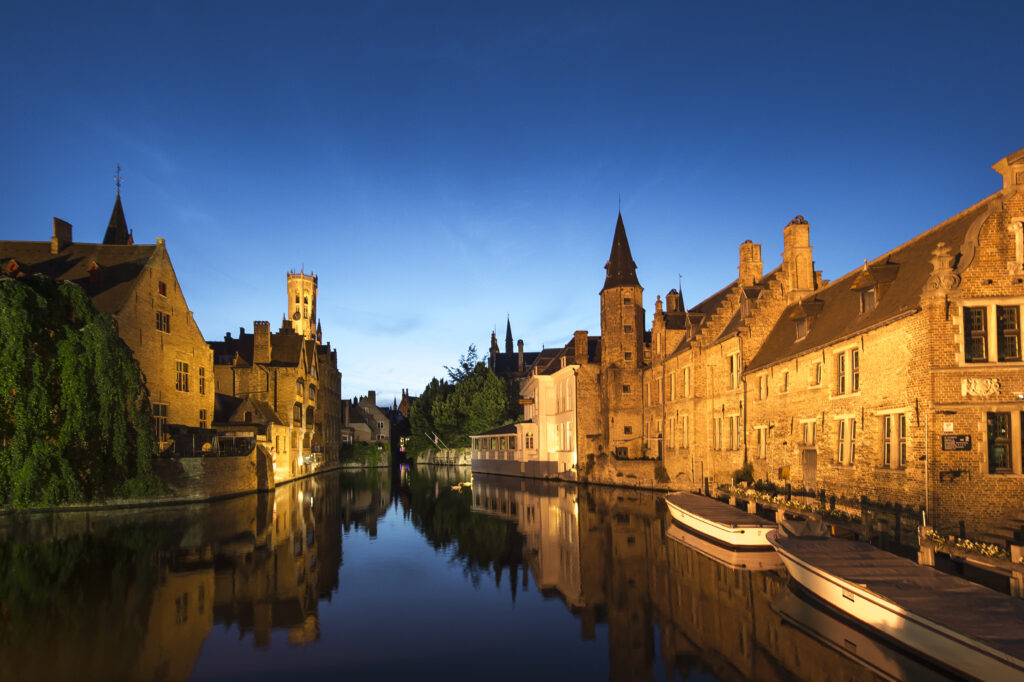
The picturesque Bruges, population 118,000, used to be a medieval powerhouse, and its history still shines through its architecture and streets. Though it’s so manicured it can feel like a theme park, there are few cities that give such intense 1400s vibes.
The city’s stepped gables—the signature rooftops of northern Belgium—line the Grand Market Square, evoking stateliness and splendour. Swans glide across canals and cobblestone alleys lead to unexpected courtyards, while the city’s air of quiet acceptance allows queer couples to feel safe and welcome.
Bruges might not be Party City, but there’s plenty of food and culture to make up for it.
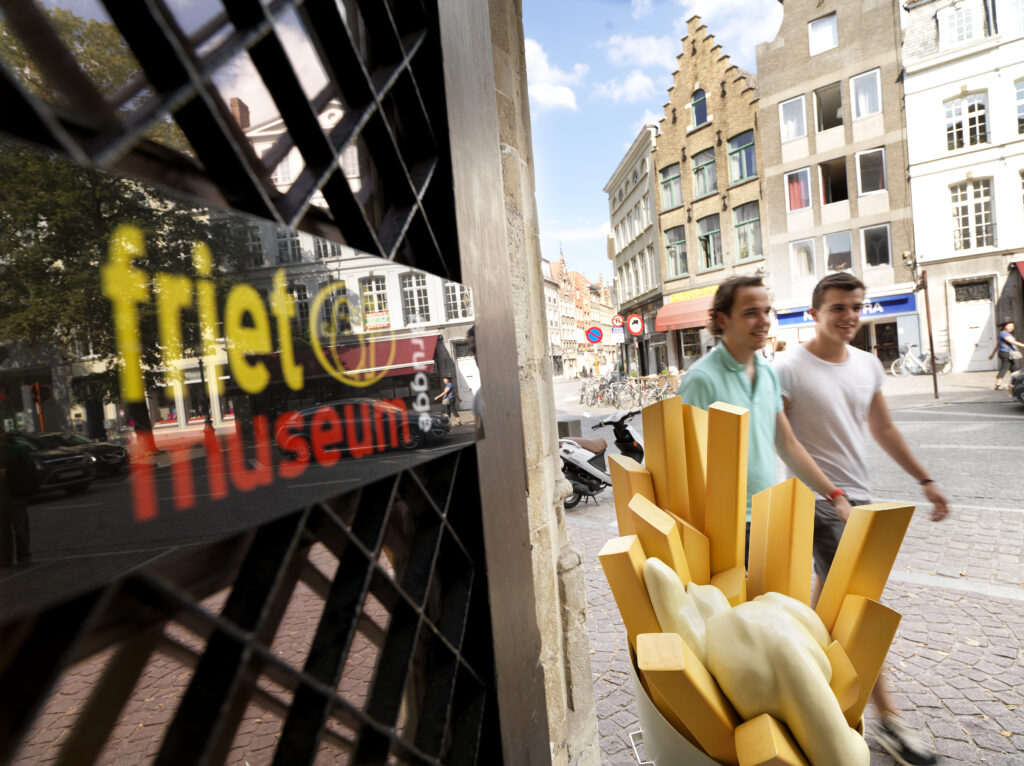
You know what food items Belgium is known for, right? Chocolate lovers must stop at Van Oost (Wollestraat 11, Bruges). Waffles are completely decadent at Otto Waffle Atelier (Katelijnestraat 1, Bruges). For fries, head to the popular Frituur De Gentpoorte (Gentpoortstraat 58, Bruges). For beer, the Beer Museum (Breidelstraat 3, Bruges) is both informative and indulgent. For a full sit-down experience of local cuisine, Bistro ’T Lammetje (Braambergstraat 3, Bruges) has traditional Flemish dishes like moules-frites and slow-cooked beef stew.
Culture vultures shouldn’t miss the Madonna and Child by Michelangelo at Church of Our Lady (Mariastraat, Bruges), one of a constellation of 12 museums run by Musea Brugge.
Though you’re unlikely to have very late nights in Bruges, those itching for queer community can find it at The Pub (Hallestraat 4, Bruges). The LGBTQ+-friendly bar hosts a social event for queer locals and visitors every second Friday of the month. They’ve also got 80 kinds of beer.
For Bruges accommodations, consider the centrally located and queer-friendly Crowne Plaza Bruges (Burg 10, Bruges).
Ghent
Ghent, which has a metro population of 560,000, has an edgy and youthful energy; it seems full of rebels and idealists. This is immediately apparent in Werregarenstraat, a mutable alleyway of political graffiti and comical street art painted by big names including ROA and Klaas Van der Linden. It’s also apparent at Casa Rosa (Kammerstraat 22, Ghent), an LGBTQ+ community centre that does a fascinating “Pink Walk” through the city’s queer past. The rebellious streak also shows itself in the nightlife: Ghent’s premier gay venue is a men-only club, a bit outside the city centre. Club Adonis (Deinsesteenweg 14, Ghent), which has lockers, a pool and a dark room, is a wild late-night haze of dancers and strippers.
Of course, not all of Ghent life happens at gay pool parties. Radical queer feminist bookstore and coffeebar Rokko (Steendam 42, Ghent) invites long conversations over coffee; they also host book readings and other events.
For a cultural breather, the contemporary art museum SMAK (Jan Hoetplein 1, Ghent) offers a top-tier collection and smart special exhibits. Fridays are for hitting up the Vrijdagmarkt (literally “Friday Market”), in the square of the same name, for quirky shopping finds and street eats.
Travellers crashing in Ghent should check out The Verhaegen (Oude Houtlei 110, Ghent), a gay-owned over-the-top B&B set inside an 18th-century manor. With only four guest rooms, it’s a private and romantic escape from the city’s bustle.
Antwerp
Compared to Ghent and Bruges, Antwerp is a glitter-drenched, loveable hot mess who’s always bringing home strange men. Home to Flanders’ largest queer population (the metro population is 1.2 million) and endless entertainment options, it’s a place to let that freak flag fly.
June sees the wildly popular “open-minded” Unicorn Festival light up the city with music, colour and unfiltered queer joy. Darklands is a multi-day gay-oriented fetish and leather extravaganza that takes place each spring; its nighttime events are male-centric (the website says men, trans men, masc-presenting and androgynous nonbinary people are welcome) while its daytime programming, including its FLINTA (female, lesbian, intersex, nonbinary, transgender or agender) program, is open to all genders. Antwerp Pride usually takes place in August.
Keep an eye out for SPEK, a raucous dance party that pops up semi-regularly in ever-changing locations.
The bar and club scene doesn’t disappoint, either. Cargo Club’s Red & Blue Events (Lange Schipperskapelstraat 11, Antwerp) throws a massive bash every Saturday (other nights are usually queer-friendly). Café Hessenhuis (Falconrui 79, Antwerp) is known for its drag shows and tightly packed dancefloor. For a full-on theatrical experience, the themed gay parties by H.I.M. (Straatsburgdok Noordkaai 3, Antwerp; other locations including IKON ANTWERP, 29 Noorderlaan, Antwerp) feels more like a queer Cirque du Soleil, complete with lights, smoke and go-go boys. For those into kink, Fetish Café (2000, Kleine Pieter Potstraat 8, Antwerp) has ropes, wax and a literal sex dungeon at the ready. It’s a pan-gender and all-orientation facility but has some gay- and queer-themed events.
Naturally, there’s more to Antwerp than nightlife. Trendy, sophisticated and forward-thinking, Antwerp is a stylish city where everyone seems effortlessly cool.
At the heart of Antwerp’s LGBTQ+ scene is Het Roze Huis (Draakplaats 1, Antwerp), a queer community centre, café, library and residence hall located in the art nouveau riche Zurenborg district.
MoMu (Nationalestraat 28, Antwerp), the city’s fashion museum, celebrates Belgian designers and international couture, while the Rubens House (Hopland 13, Antwerp) showcases the works and lifestyle of the iconic 17th century Flemish Baroque painter. MAS Museum (Hanzestedenplaats 1, Antwerp) is a strikingly modern building with panoramic views and exhibits exploring Belgium’s global identity.
For accommodations in Antwerp, Radisson BLU (Koningin Astridplein 7B, Antwerp) is right across from Centraal Station, steps from gay nightlife and even home to its own aquarium, Aquatopia.
So, whether it’s medieval streets, queer history or sweaty sunrise grindfests, the cities of Flanders offer something for everyone in the acronym.