I had never planned to go to Bratislava. But when I travelled recently to Vienna, Austria, the new home of an old friend, I quickly learned that the capital of Slovakia was only one hour away by train. Following the recommendations of a few queer travel buddies, and drawn by the promise of hearty Slavic food, I grabbed a ticket. I was not disappointed by the city, nor by its queer scene.
The first thing I noticed as my train approached the city of 480,000 was Bratislava Castle (Hrad, Bratislava). Bright white with a rust-coloured roof and four turrets erupting from each of its corners, it’s a landmark that’s hard to miss. Looming over Bratislava and the Danube River from its perch on a rocky hill, it’s a fitting guardian. Then, on the far bank of the Danube, I glimpsed a massive tower topped by a UFO-shaped disc. This futuristic UFO Tower, which sits atop the SNP Bridge, which opened in 1972, couldn’t have been more different from the historic 13th-century castle. These two key monuments—one modern, one ancient—are strange bedfellows but make sense in the history of Slovakia.
As I began to explore the city, I discovered even more surprises. “Čumil,” a bronze statue of a man crawling out of a manhole cover, rose from the sidewalk across from a Burger King. A Hans Christian Andersen sculpture stood along the city’s riverside walkway, surrounded by smaller sculptures of Andersen’s literary creations, including a giant snail from “The Snail and the Rosebush.” I soon learned that these statues were part of a citywide reinvention that took place after Slovakia broke from the Soviet Union’s Communist influence in the early 1990s. Bratislava wanted to create a quirky new identity for the city’s public monuments, one free of ideological statements. They went with an array of sometimes quirky depictions of local and international cultural figures.
Slovakia as an independent country is only 32 years old. But the culture itself has a history going back thousands of years including Roman, Moravian and Austro-Hungarian rule. It became part of Czechoslovakia in 1918, when several unrelated parts of the collapsing Habsburg empire were brought together under one flag. After a Slovakian flirtation with Hitler’s fascist coalition in 1939, Czechoslovakia was absorbed, against its will, into the Russian-led Eastern Bloc that followed the Second World War. When Soviet Communism collapsed in 1989, Czechoslovakia peacefully split into two countries, Slovakia and what is now Czechia (also called Czech Republic), in a 1992 separation called the Velvet Divorce. While modern Czechia is considered more cosmopolitan, more aligned with Western Europe, Slovakia is seen as more traditional, a little more off the beaten path, but also friendlier and more approachable.
To be honest, I felt a bit apprehensive visiting a former Eastern Bloc country. I knew nothing of the language: words on signs seemed to wear čurvy hatš over their heads, a hallmark of Baltic, Slavic and Finnic languages. Furthermore, there were the stereotypes I had recently heard from fellow travellers and which had been magnified by Hollywood depictions of Eastern Europeans: stern and well-built ultra-religious working men; strong-jawed women who could lift whole goats over their heads. Not to mention the Eastern Bloc’s known for being more homophobic than Western Europe.
But while I certainly saw hulking men with grim, distant looks on their faces as I toured the city, there were just as many warm and accommodating locals, some of whom, of course, were queer. Bratislava, and by extension Slovakia, is a place where LGBTQ+ people have fought for their right to exist. Just as Slovakians won independence from Austro-Hungary and, later, Soviet control, the country’s queer citizens have gradually been winning the right to love. Slovakia has yet to pass marriage equality, though there are anti-discrimination protections, hate-crime laws and access to gender-affirming care. The national government, and national attitudes, haven’t fully embraced queer communities, yet Bratislava itself is a hub of youthful musicians, students, experimental art galleries and hollering drag queens. The cultural scene is easy to access and reflects many of the themes and tensions we see in other countries. The ageless Danube is dotted with noisy cafés, including one where I was drawn into a lively conversation about an upcoming hip-hop music fest, the Rubicon Festival, which had been slated to feature Ye (né Kanye) until thousands of Slovakians signed a petition condemning the rapper’s recent single that glorified Adolf Hitler. The festival was ultimately cancelled.
Meanwhile, I tried every new Slovak dish that caught my eye. First, there was the beloved national dish bryndzové halušky, a hearty potato dumpling stew topped with bacon and cheese that weighed me down for at least two hours afterwards. Then there was Zemiakové placky, which consisted of fried potato pancakes served perfectly crispy with a dash of garlic. There was also goulash, which while not strictly Slovakian is still a satisfying paprika-laden meat stew that pairs well with Pilsner. At the queer-friendly restaurant Fach (Ventúrska 10, Bratislava), such traditional dishes are updated with experimental cooking methods and creative presentations. Fach also has an excellent wine selection.
To top it all off, I tried trdelník, or chimney cake, which is a sweet pastry wrapped into a spiral and served as street food. It was the perfect companion for my stroll through the cobblestoned streets of Bratislava’s historical centre, where souvenir shops are peppered among Gothic buildings that date back to the Middle Ages. I ended my journey at the baby blue-hued Church of St. Elizabeth (Bezručova 2, Bratislava), whose ornate mosaics and sinuous curves, inspired by the early 20th-century Hungarian-Secessionist architectural movement, have made it a popular Instagram photo-op.
But no matter how much I loved immersing myself in this new culture, there was also a whole underground queer scene to discover as well. Check out my best recommendations below.
Although I did not spend the night, those looking to spend a few days will find that the Crowne Plaza (Hodžovo námestie 2, Bratislava) is centrally located, lavishly decorated and explicitly LGBTQ+-friendly.
Where to party in Bratislava
Visitors who are looking to find out what parties and events are happening should check out Tepláreň and Queer Slovakia, two online publications that post the latest news on drag shows, queer DJ nights and other festivities.
For those who can’t sync their visit to scheduled parties and events, Bratislava has several reliable hotspots that the local LGBTQ+ community turns to. Ruido.cafe (Michalská 7, Staré Mesto, Bratislava) is a gay bar in the city centre with cocktails, DJ sets, live music and even English-language comedy shows.
Apollon (Panenská 24, Staré Mesto, Bratislava) is the oldest gay bar and club in Slovakia, with cocktails and dancing in a safe space. Depending on the music—drum and bass, retro and tributes to pop divas, for example—the crowd can have a different vibe.
For something more fashion-forward, Šafko Klub (Šafárikovo námestie 7, Staré Mesto, Bratislava) hosts queer EDM parties, including the regular Tepláreň kabaret & párty, and is also gay-friendly on its other nights.
Urban House (Ground Floor, Laurinská 213/14, Bratislava) is a popular starting point for gay nights out thanks to its sophisticated cocktails, Insta-friendly rattan lamps and disco lighting.
Nová Cvernovka (Račianska 78, Bratislava) is a queer-friendly cultural centre, loved for the sheer variety of what it has to offer. There’s a café, a coworking collective, a theatre, a space for dance parties and even a garden filled with free-range chickens. As a cherry on top, it all happens in a former high school chemistry building.
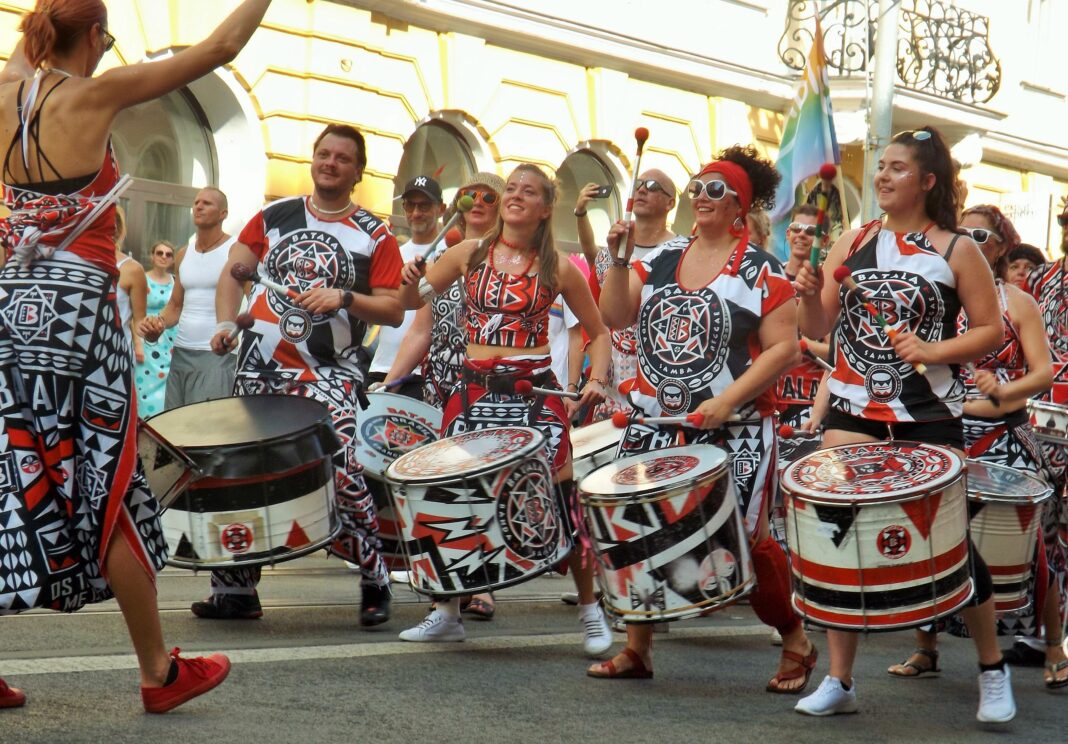
Then again, it seems like every venue in Bratislava becomes a queer bar or club during Dúhový PRIDE Bratislava (July 18, 2026). Though it has occasionally faced protests from the far right since the event’s founding in 2010, Bratislava citizens have been increasingly directing their support toward it. Now, it celebrates the diversity of not only the Slovakian queer community but also Slovakian culture itself: Performers run the gamut from local ballroom icons to nationally renowned folk-pop singers. It is also becoming increasingly globalized, featuring political speakers who aim to bring Slovakia closer to the “open and democratic countries of Europe.”
Perhaps as more trepidatious queer vacationers continue to brave the short train ride over from Vienna and, like me, discover the riches that Bratislava has to offer, that vision will soon become a reality.