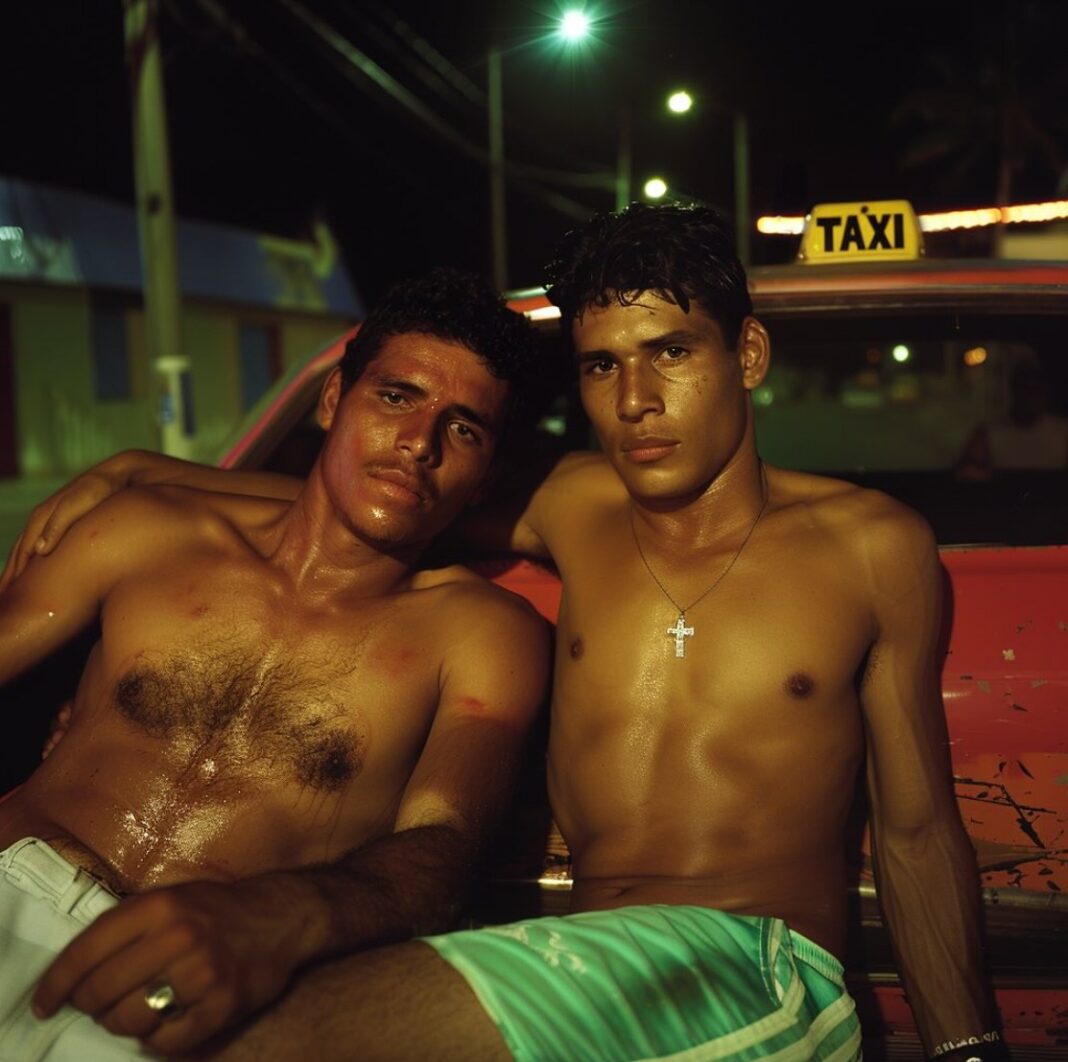
Photographer Matías Sauter Morera made history—a little dent at least—when a homoerotic image he created became the first AI-generated work bought by the Getty Museum in Los Angeles, California, in early 2025.
The Costa Rican photographer, who’s lived part time in Berlin since 2012, wanted to capture a very queer part of his birth country’s history. He spent weeks creating the AI prompts to get the sexy images just right—they’re inspired by real-life experiences but fuelled by fantasy. It seems like there is an appetite for sexy 1970s tico cowboys who swing both ways.
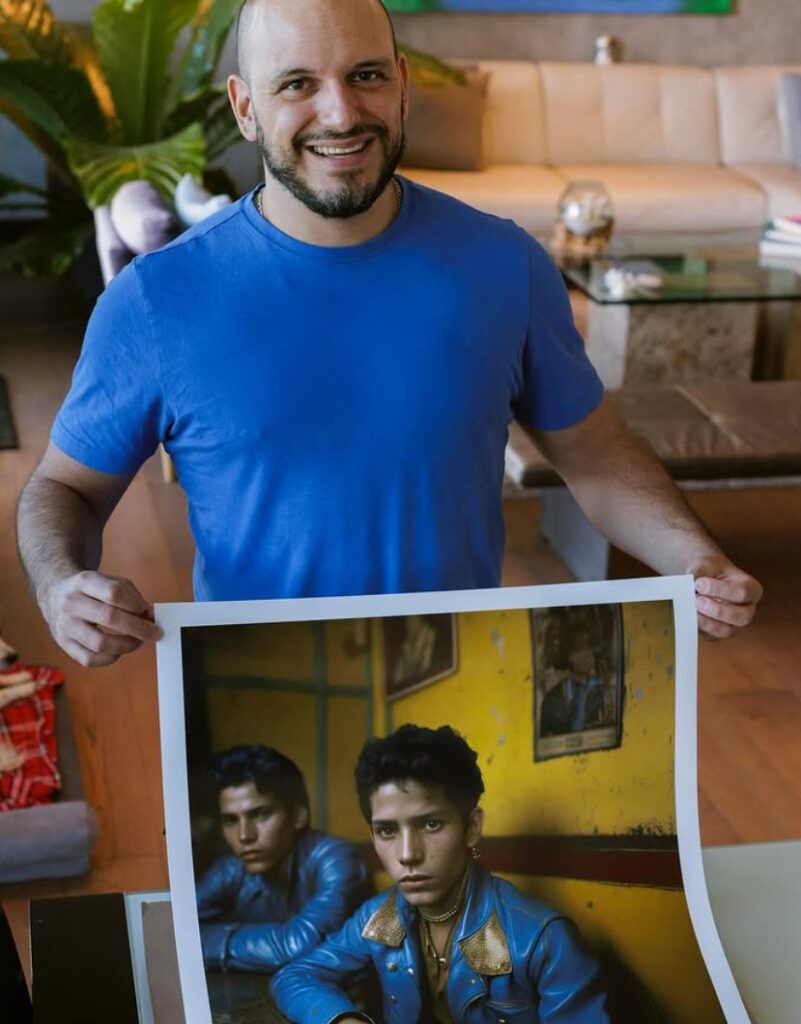
Sauter Morera’s art also includes landscapes and other slices of modern life that he captures using a camera. His commissioned photographic work has appeared in publications such as Condé Nast Traveler, Vogue, Harper’s Bazaar and Cosmopolitan, which he mostly shoots in Berlin. But Costa Rica remains the primary source of his artistic inspiration.
Wander+Lust talked to Sauter Morera about his images of hypermasculine sexually flexible cowboys and about gay life in Costa Rica.
It was a big deal when the Getty Museum in L.A. acquired a work from your Pegamachos series and included it in its Queer Lens exhibit this summer. There was some controversy that it was an AI-generated work. How has that affected your life?
It was a bit crazy because I had not had this before. I was not expecting that it was gonna be big news. I didn’t realize it was the first piece that they had collected that had been done together with AI. The visibility has been great—I’ve been contacted by a lot of people interested in my photography and also for acquisitions. It’s also been a great learning opportunity for me because you get more into and more up-to-date on what’s happening in the art world.
Pegamachos is an imaginary world, with imaginary hot guys, based on a real phenomenon that happened in Costa Rica in the 1970s and ’80s, straight cowboys having sex with gay city boys. Perhaps it still happens today. Can you tell me how you came up with the idea to turn that into AI art?
Pegamachos started when I was exhibiting pieces from a series New World Tropics, based on landscape photography in Costa Rica. When I moved to Berlin, I started having many memories about Costa Rica and asked myself: What is my identity in relation to Costa Rica? I remembered images in the car with my parents, watching nature in the darkness, like when you go to the beach and it’s lit up by car headlights. I started thinking more about the history of the countryside in Costa Rica.
I heard about the pegamachos when I was 19 years old. Some guys I knew were travelling to Guanacaste, in the northwest of Costa Rica. I grew up in the capital, San José, which is about five hours away. They were like, “Hey, do you want to come with us? We’re gonna hunt pegamachos in the rural areas.” They told me in certain bars, certain places in rural areas of Guanacaste, there was this cowboy community where the economy is based on cattle ranching. It’s where you could find these heterosexual men, and if you were a visitor, and if you were gay, they would get into sexual interactions with you, but they would never consider themselves gay. I got super interested in this and had a lot of fantasies of myself being with a pegamacho. Over the years, I heard a lot of stories from people, but just here and there, because it was so hidden. I did recordings of people in the community in an anonymous way. I started doing photos of cowboys in the community, but I didn’t want the models to be the subject of discussion. I was like, “How can I revive this story?” When I got acquainted with AI, it just clicked.
And um, to be perfectly clear, did you ever hook up with a pegamacho?
I wish, but not so far.
You moved to Berlin in 2012 and since then you’ve split your time between there and Costa Rica. What brought you to Germany?
It was just a decision of adventure. I have a German grandfather. My grandfather Franz was very strict about us learning German, so we went to German school; the German public system is part of the public education system in Costa Rica. So I speak German. I have a German passport. Why not live for a while in a different place, in a big city? I come from such a small country. Later I understood that one of the reasons to be in Berlin is that you meet such a vibrant and open queer community. You meet so many types of gay men and other queer people who have so many views of themselves, how they see themselves in love or growing older or what it means to be gay. It just opened my mind so much.
Costa Rica’s gay community is great. But when I was growing up, it was still quite conservative. So having an amazingly open queer community is one of the reasons I decided to stay more and more in Berlin. I work commercially here with portraiture and fashion and dance.
I usually spend the four winter months in Costa Rica, which is when I work on my art projects. I do scouting for locations, do my travels for the Tropical Nature series, interviews for Pegamachos. I knew I wanted to have one foot in Germany, one foot in Costa Rica, so I could always go back and forth.
What’s your number one place to hang out in Costa Rica?
Definitely Punta Uva, close to Puerto Viejo, on the Caribbean side of Costa Rica. It is exuberant. Nature there is wild and green. The beach is a paradise. It’s not only the sun, because it rains a lot and you get these tropical storms. The culture is Caribbean. Because there is lots of immigration from all over the Caribbean, we have a very big Afro-Costa Rican community and I love the atmosphere.
Lately I’ve been going to the mountains near San José, particularly the Barva Volcano, an inactive volcano that has forests, hiking trails and crater lakes. It’s an amazing place to work on artistic things because it’s cold, maybe 17, 18 degrees celsius, but then when you go down the mountain, it’s hot.
How much has gay life changed in Costa Rica in the last decade or so?
There has been exponential change. Costa Rica has always been a very open place to be in Central America. We’ve always had gay people from Guatemala, Nicaragua, as it is way more open in Costa Rica than in their countries. We had a lot of gay bars, clubs, darkrooms, drag shows. Actually for a very small city [fewer than 400,000], I am very impressed by the number of places you can go. And by the openness. I have seen many people comfortably being trans, nonbinary, in San José, seen how everybody goes to the gay clubs.
Do you have some favourite places to go out to in San José?
It depends what you want to do. I do like the darkroom bars. There’s one called Puchos Men’s Club (Cl. 11, esquina Ave. 8, San José) that also has male stripper shows, which is something I don’t see in Berlin. The strippers dance, they show their stuff. You can have nice chats there. There’s also a lesbian bar I love, La Avispa (Cl. 1, entre Avenidas 8 y 10, San José, Costa Rica), which means “the wasp.” It’s legendary with the gay and lesbian crowd. They play a lot of cumbia, salsa, swing, criollo—really Latin music. People dance to this, couples’ music, very romantically. Coming from Berlin, where everybody dances to the DJ, seeing people dance romantically is beautiful.
And for some daytime activities?
San José is not the most vibrant city. You can go to the Teatro Nacional de Costa Rica (Av. 2, esquina C.. 5, Catedral, San José) to hear the symphony. But mostly I like to go see nature, which is very close. Travel about 40 minutes, maybe an hour, and you can spend the day climbing a volcano.
You mentioned you love Punta Uva on the Caribbean coast. What are some other favourite beaches?
On the Pacific coast, I’ve been going a lot to Flamingo Beach, in Guanacaste. I also love Montezuma, which is further south, on the Nicoya Peninsula. Near the village of Nosara, there are several nice beaches like Barrigona, which is a small beach but very beautiful.
The Manuel Antonio area, which is a resort area near Parque Nacional Manuel Antonio, has a gay reputation.
I haven’t been. I know there was a hidden gay beach, which was called Playitas, but it’s become more developed—the bars and hotels started coming—so it’s not the same anymore.
This interview has been edited for length and clarity.