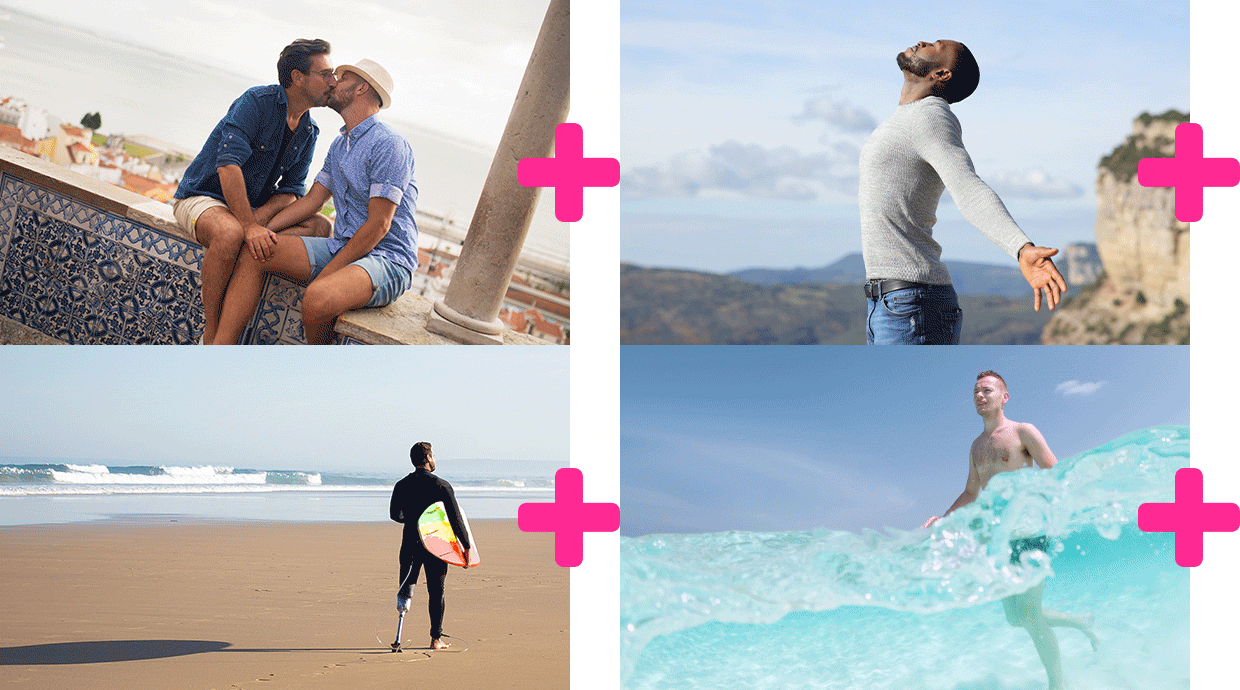
For LGBTQ2S+ travellers who love one-stop shopping, you can’t beat a gay village. In the world’s favourite queer cities, that’s where you’ll find an abundance of bars, clubs, saunas, boutiques and LGBTQ2S+-run and -friendly restaurants. If you don’t like the look of the venue you’re standing in front of, you can try the one next door or the one just down the block. It’s a buffet of homosexuality.
But sometimes these gaybourhoods are a little too gay. Our travel preferences can be dictated by other factors (alt culture? foodie? proximity to certain non-gay experiences? lack of interest in mainstream gay culture?)—or maybe we simply enjoy being around some straight people.
Here are seven alternatives to famous gaybourhoods around the world.
1. Lisbon, Portugal
Instead of Príncipe Real and Bairro Alto, try Arroios
Príncipe Real has long been Lisbon’s gay village, with a high density of clubs, bars and other venues frequented by locals and visitors alike. Meanwhile, Bairro Alto is the “mixed” party zone, with dozens of tiny bars along the district’s long narrow streets. But Príncipe Real can feel a bit too slick, and Bairro Alto is mostly dead during the day.
Arroios, by contrast, feels like a real 24/7 neighbourhood where queers live and go about their daily lives. With lower rents, it’s where you’re more likely to run into younger queer, trans and nonbinary people, as well as immigrants from South Asia, Africa and Brazil, giving it a more colourful flavour. Though not as many venues are “branded” as LGBTQ+, there are community spaces, performance venues and events that capture intersectional queer culture.
Key venue
Drama Bar (R. Damasceno Monteiro 75B, Lisboa). Alternative drag and cool music are the defining features of this capital-Q Queer bar.
2. Mexico City, Mexico
Instead of Zona Rosa, try Ciudad Juárez
Astute readers know this recommendation doesn’t make sense. Zona Rosa, the super gay party district between Reforma and Glorieta de los Insurgentes, is actually *in* Juárez, though the Pink Zone has become more famous among visitors than the district it calls home. Our suggestion is to cross Avenida Insurgentes to explore the other half of Juárez, where you’ll see fewer rainbow flags and fewer plastered twinks, but find a more sophisticated and mixed scene.
Juárez east of Insurgentes is much less touristy than Zona Rosa, so there are fewer chain restaurants and stores, more one-of-a-kind enterprises, but it’s not quite as hipster-focused and full of American digital nomads and trust-fund kids as Roma Norte.
Key venues
For a cool, mixed crowd, try Loose Blues (C. Dinamarca 44, Juárez, Cuauhtémoc, Mexico City), a resto-bar somewhat hidden above a beautifully curated lifestyle boutique. Think Japanese fusion, DJs and cocktails with fresh ingredients. For the party boys who take their shirts off when they get too hot dancing to techno and house, there’s SIC (C. Versalles 64, Juárez, Cuauhtémoc, Mexico City).
3. Berlin
Instead of Schöneberg, try Wedding
Berlin already has an alternative queer neighbourhood to Schöneberg in kooky Kreuzberg, one that’s a bit artsier and mixed than the man’s-man bars you’ll find along and around Motzstraße. But even Kreuzberg can be a bit much, so we’ll head north of Mitte to a formerly working-class neighbourhood. In recent years, Wedding has been a magnet for queer women, trans and nonbinary people, artists and migrants (and various combinations thereof) who have been priced out of other parts of the city.
Full of community-minded little bars, DIY workshops and pop-ups, especially along Müllerstraße, Wedding is a less crowded, less touristy and more lived-in experience for visitors who’d rather drink coffee among cutting-edge locals than in spots designed for Instagram selfies.
Key venue
Curly Bar (Adolfstraße 17, Berlin). There’s a party, show, karaoke, fundraiser or themed dating night (fluid 4 fluid, over 35, pan and bi, etc.) pretty much every night of the week at this very consciously inclusive community hub.
4. New York City, New York
Instead of Hell’s Kitchen and West Village, try Bushwick
Manhattan’s busiest gaybourhoods offer classic NYC gay bars—polished refuges from the city’s hustle and bustle. Though they often have very gay hustle and bustle of their own. Brooklyn’s Bushwick offers a rawer, more grassroots queer experience rooted in art, DIY community, and a less socially and demographically stratified social landscape. The neighbourhood’s industrial spaces have been transformed into galleries, street-art corridors and performance spaces where queer creatives and allies showcase work that feels immediate and authentic.
It’s a place where drag shows are staged in punk bars, queer DJs draw on global sounds, and underground cultures, brunch spots and cafés double as queer meetup hubs during the day. Invite a hottie for a hang in Maria Hernandez Park.
Key venue
House of Yes (2 Wyckoff Ave., Brooklyn, New York City). Celebrated for its boundary-pushing gender-bending shows, immersive dance parties and radical inclusivity, you just know that House of Yes was founded by artists of all identities, expressions and orientations.
5. Melbourne, Australia
Instead of Collingwood & Fitzroy, try St Kilda
The neighbourhoods of Collingwood and Fitzroy are jointly Melbourne’s de facto gay village; the street dividing them, Smith Street, was named the coolest street in the world in 2021 and is where visitors will find most of Melbourne’s LGBTQ+ nightlife. Yet, around 20 years ago, Melbourne’s queer centre of gravity was St Kilda/Commercial Road, which from the 1970s to the early 2000s was the place to see and be seen.
But the past can be a lovely place to escape into, especially when it’s a pleasant upscale beachside neighbourhood. St Kilda offers palm trees, ocean breezes and a more relaxed vibe than Smith Street—Sunday markets rather than sweaty dancefloors. St Kilda is also home to the annual Midsumma Pride March (usually February; 2027 dates TBD).
Key venue
Victorian Pride Centre (79-81 Fitzroy Street, St Kilda). Australia’s first purpose-built centre for LGBTQ+ communities opened in July 2021, offering health services, community spaces, a theatre, a gallery, a rooftop terrace with panoramic bay views and a home for queer bookshop Hares & Hyenas.
6. Barcelona, Spain
Instead of Eixample, try El Poble-sec
Eixample is jokingly called “Gaixample” for a reason. Along its grand boulevards and grid-like streets are the deepest concentration of gay bars, clubs, saunas and shops, mostly centred around Carrer Diputació. It’s a lot to process.
For something quieter and more lived-in, try El Poble-sec, a bohemian neighbourhood where queer life and nightlife are much less focused on tourists. Think brunch and vintage furniture rather than sweaty dancefloors. The neighbourhood sits at the base of Montjuïc, giving visitors easy access to green spaces and cultural sites.
Key venue
La Federica (Carrer de Salvà, 3, Sants-Montjuïc, Barcelona). With its pastel 1970s-themed furniture, staff dressed in brightly hued shirts and fanciful themed parties, this little bar has a lot of unpretentious high energy. Unhinged drag and other random entertainment.
7. London, UK
Instead of Soho, try Dalston
Like many of the alternative ’hoods on this list, Dalston defines itself by—and excels at being—what its rival, Soho, is not. Which is to say that Soho attracts mostly gay-identified men, meets established expectations of what gay nightlife looks like and can feel a little stand-and-model. If you get bored in one Soho venue, there’s a similar one next door you can try.
Dalston, meanwhile, feels more alternative, more queer, more creative, more pan-acronym inclusive and more ethnically diverse. It’s not as densely packed a neighbourhood, and visitors have to do their research to find out what’s happening where and when, but it’s worth it if you love things hip, artsy and cutting edge. Although it’s gotten slicker over the years, the scene’s origins in squatter parties and DIY events still show.
Key venue
Dalston Superstore (117 Kingsland High St., Dalston). Founded in 1998 by drag artist and nightlife impresario Jake Blanchard, Dalston Superstore is a one-stop shop for East London’s left-of-centre queer culture. Depending on the night you drop by, you can experience a drag show, cabaret, poetry slam or open mic night—or something uncategorizable.