I first visited Zipolite about 15 years ago. I had heard about Mexico’s only recognized clothing-optional beach several years earlier from—wait for it—a straight female friend. She has a bohemian bent and discovered the beach town during a backpacking tour around Mexico. She loved the hippie vibe and thought I would love it, too. For decades, that was Zipolite’s reputation within Mexico: a hippie place where (this wasn’t part of her recommendation) freaky people did drugs. It wasn’t a place a nice Mexican would tell their mother they were visiting. And the waves could be very dangerous; the name comes from the Zapotec language and means “Beach of the Dead.”
Zipolite gained a small reputation as a countercultural destination in the 1960s. It was solidified in 1970 when a group of hippies came to watch a rare solar eclipse. Locals were tolerant of these visitors, and their desire to be naked, as long as they were spending money and not being too vulgar.
In my memory, my friend never mentioned that it was popular among gay men, so that could not have motivated my first visit. I just wanted a laidback beach town where I could relax, reflect and do my own thing, which disqualified Puerto Vallarta, Cancun and most of Mexico’s and the Caribbean’s major beach destinations. One of my favourite films is director Alfonso Cuarón’s Y Tu Mamá También, a sexy and melancholic road trip movie from 2001. I wanted to find a beach just like the film’s protagonists—played by Diego Luna, Gael García Bernal and Maribel Verdú—happened upon. In Cuarón’s fictional Boca del Cielo (“Mouth of Heaven”), shot on a beach not far from Zipolite, the characters bond with a local fisherman, watch fresh seafood being prepared for dinner, have beers in a thatch-roofed palapa and make out with each other (it’s a complicated lust triangle). I wanted those simple pleasures. I could see on maps that at the far east end of Zipolite’s large runway-like beach is a rocky promontory with rock steps leading to a small cliff-encircled cove called Playa del Amor (“Love Beach”). Playa del Amor must be as romantic as Mouth of Heaven, no?
Over several visits, I fell in love with this tiny, remote and remarkably under-developed beach paradise. I wouldn’t call myself a nudist, but I enjoy swimming naked and am happy to socialize with other naked people. Back in the ’10s, it had maybe a couple of dozen small backpacker-y hotels and a couple of dozen eating establishments, only a handful of which would qualify as full-fledged table-service restaurants. Until very recently, Zipolite had only one ATM, a particularly unreliable one at that. The town still has no chain businesses. During my first visit, the internet went out for almost a week, and whenever I walked along the main road, I could see the severed cable hanging there, waiting to be repaired. (The internet remains terrible to this day.)
But I have avoided writing much about Zipolite because it felt like a secret that should be shared only with the right type of gay traveller. Someone who will reply with a smile to anyone who strikes up a conversation with him, someone willing to share a bit of himself with strangers. Someone who is willing to step outside his tribe, tap into a more vulnerable, less status-conscious version of himself and set aside various judgements and expectations. Someone who gets pleasure from doing nothing but taking long walks on the beach. That’s the kind of person I wanted to slip the card that says, “You’ve got to go Zipolite!”
Then in 2022, The New York Times published the article “This beach in Mexico is an LGBTQ haven. But can it last?” To which I sarcastically replied, “Not very long now, thank you very much, New York Times, for ruining everything.”
I can’t do any more damage than that article did, so here it goes.
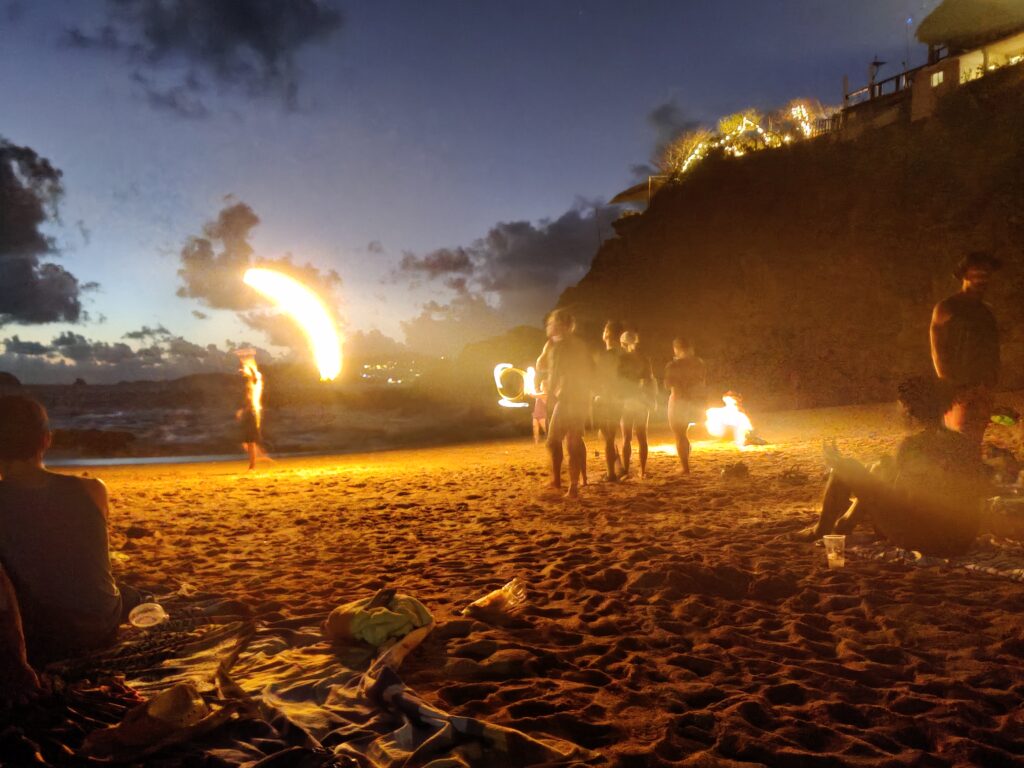
When she visited in the early 2000s, how would my straight female friend even have known Zipolite had a gay following? Back then, the tiny hard-to-get-to beach town in Oaxaca, one of Mexico’s poorest states, was probably attracting just a few hundred visitors each week, maybe less. The naked gay men were mostly mixed in among the naked/bohemian straight people, only becoming obvious when they were discreetly eyeing each other (and more) on the beach. I figured it out during my first sunset, when I was walking down the beach and a guy I could only see in silhouette walked right up to me and gave me one of the most sensual kisses I have ever experienced. When it happened again two nights later, with another guy on the beach, I knew I had stumbled onto something remarkable.
During my first few visits, back in the 2010s, I would bet that there were only rare occasions where more than 40 or 50 gay men were in town on any given week. I say this with some confidence because, in those days, on Playa del Amor, where most of the gay guys hang out, I counted how many people were there for sunset. My count never went over 35, even on the weekends, when Mexican guys from the region would come to Zipolite for short escapes, bumping up our numbers. On a Wednesday sunset in January, there might be 12 or 14 of us, mostly solo or in couples. Some of us would keep to ourselves, reading, tanning, pacing around. But there would be chitchat, especially when there were a few people in the ocean, playing in the waves, our heads bobbing above the churning water. Though there were guys from various countries, and of all ages and backgrounds, I noticed an overrepresentation of creative types: choreographers, theatre designers, writers and the like, especially those visiting from Mexico City.
Only after a couple of visits did I realize that guys were staying on the beach after dark to fool around. Was I naive? Probably. But remember, there might have only been a half dozen who dared stay late on the beach any given night. Then there were rumours that the police were cracking down on beach cruising. During a visit in 2016, there was a sign erected on the steps to Playa del Amor that there was no tolerance for sexual activity on the beach. That sign was gone the next time I was there.
Although Zipolite’s two-kilometre-long beach, including Playa del Amor, is clothing-optional, the town itself is not. Most businesses require a minimum of a sarong, and I’ve never seen anyone naked in the streets. Generally speaking, it’s not a sexually charged place unless you’re looking in the right places. Straight naturalists, who have for decades made up a large portion of visitors, tend to frown on sexualizing nudity. Although the main industry is tourism (as well as fishing), it’s a real town, population 1,060, with a church, schools and municipal government.
For a long time, the gay vibe was subtle and underground—no rainbow flags. Then something happened around 2018, 2019. I want to blame it on two particular American guys who I have seen on the beach over the years—hot, charming guys with large social-media followings. Over time, I think there was also enough published about Zipolite that it started popping up in search results for the Google query “gay nudist beach.” In 2015, El Alquimista opened, probably the first upscale non-backer-style property. Their rates at opening were around US$100, which seemed outrageous for Zipolite at the time. Suddenly, a visitor to Zipolite could have a more refined experience, with more sophisticated design and a more thought-out menu. You could sit on the beach in comfortable patio furniture, not on a towel or plastic chair. Maybe that was a tipping point. Or maybe it was when the local council voted in 2016 to make the beach legally a nudist beach—until then it was merely tolerated, not legal. Someone could write a master’s thesis about how trends take off.
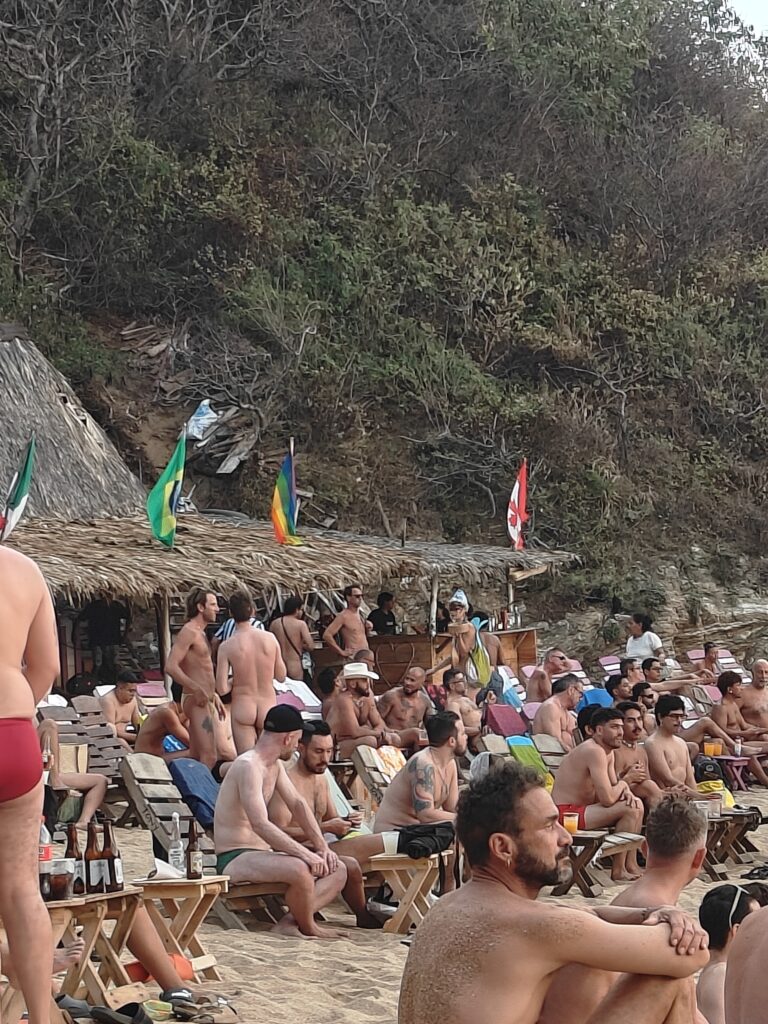
All I know is that when I went to my first Zipolite sunset during a February 2021 trip, my first since the beginning of the pandemic, there were more than 200 guys crowded onto Playa del Amor. Many of them were in groups—six, ten, a dozen—most wearing fashionable bathing suits rather than birthday suits. I’ve heard regulars call them “the Fire Island boys” or the “American hipsters.” Whatever they are, they tend to stick to their own kind and will form their beach chairs into half-circles, forming an ersatz wall on Playa del Amor. During that 2021 trip, I remember watching a handsome-but-not-trendy Montreal guy try to chat up a group of Fire Island boys and seeing them one by one turn their backs on him. It made me sad. Mean girls.
Because most of the Fire Island boys are hot (well-groomed, at least), they attract a lot of attention. But then they mostly don’t want to interact with anyone not already in their clique or up to their beauty standard. So their Instagram-obsessed behaviour kills the vibe for everyone. There tends to be more of them around New Year’s. On my most recent trip in mid-January 2026, they were a small minority that other, more independent-minded gay visitors learned to work around and laugh at. I was at one Sunday afternoon pool party at a local hotel. Early in the party, it was a wide mix of gay guys: different ages, backgrounds, body types. It was flirty and friendly, everybody talking to everybody. Then, like a tour bus had pulled up outside, two groups of Fire Island boys walked in, about 20 of them added together, their bathing suits reflecting the season’s best looks, and suddenly everyone got more uptight and inhibited.
As a long-time fan of Zipolite, this is annoying. But the countercultural all-inclusive vibe is still there, and there are enough non–Fire Island boys who are willing to leave their attitudes at the door.
This last visit, someone on the beach asked how Zipolite has improved over the last 15 years. I would say that the higher number of visitors means there are more people to meet and cruise, more eye candy to look at. Visiting gays are more likely to find someone they form a stronger connection to, rather than a casual one. Still, we’re talking about a tiny percentage of what a visitor to Puerto Vallarta would find.
These days there are nicer places to stay and nicer places to eat, and many of the new places have a stronger sense of style, more personality, creativity and global influences, than the legacy businesses. There is more nighttime activity: a bar where there’s dancing, a naked-only gay bar, more venues that feature live performances. And there are tours on offer, for those who need more than sun, sand, nudity, beer and tacos to fill their days.
But the thing I love best is that many of the legacy businesses—cheap local restaurants, no-frills hotels—have survived. Some have evolved. The guy now selling beer and cocktails on Playa del Amor out of a permanent palapa, with servers bringing guests drinks to their chairs and umbrellas, is the same guy who sold me beer out of a cooler in 2012. Yet many have the same ambience (often zero ambiance) and menu they had in the 2000s. One beachside resto-hotel even dates back to 1968.
So I embrace what’s new in Zipolite, so long as it doesn’t drive out what made the place special in the first place. Here’s hoping other feel the same way.
Read our quick, dirty guide to Zipolite here.