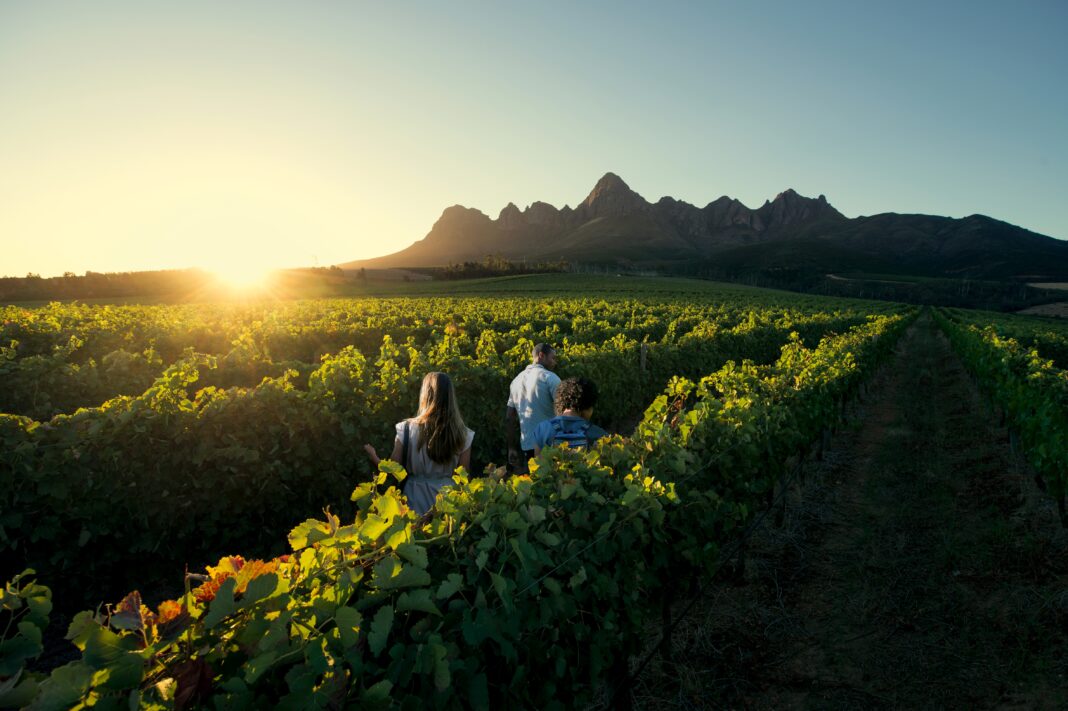
Not all visitors to South Africa define their “Big Five” as lions, leopards, rhinoceroses, elephants and Cape buffaloes.
No, some travellers are on the hunt for Cabernet Sauvignon, Shiraz, Merlot, Sauvignon blanc and Chenin blanc—the five most popular wines produced in South Africa’s Cape Winelands. Rather than riding in an offroad vehicle around savannas and deserts, these oenophiles tour by car, tram, bike and foot around lush valleys dotted with cute towns. Instead of flying into far-flung national parks and game reserves, they day trip or escape for a few days out of Cape Town, a wonderfully LGBTQ+-welcoming coastal city that’s less than an hour’s drive away from wine country. (Read our insider’s guide to the Best of LGBTQ+ Cape Town here.)
A wine safari might not feel as thrillingly bestial as watching lions stalk their prey. But who needs bestial when there are crudités being served with unoaked Chardonnay from, say, Jordan Wine Estate (Stellenbosch Kloof Rd., Vlottenburg, Stellenbosch)? If hunting with a camera is a more humane form of stalking wildlife, then hunting with one’s taste buds must be ridiculously ethical. And who says you can’t do both kinds of safari while in South Africa? When the Northern Hemisphere gets unbearably cold, a journey to the 34th parallel south is not a mere escape, it’s an opportunity for discovery and conviviality.
Though the Cape Winelands can be navigated independently, the attractions (i.e., wine and beautiful scenery) are mostly in the countryside. So travelling by private vehicle or a tour bus is usually the best way to get around (with the exception of one route I’ll mention later). Going with a tour company—either a local one or as part of a larger tour to South Africa—can make it easier to navigate among the wineries and scoot from town to town. The sociability of a wine adventure also makes it conducive to travelling with a group, whether it’s friends or like-minded fellow tour members. Several LGBTQ+-focused tour companies include a visit to the region as part of their larger South African itinerary.
The Cape Winelands has more than 500 wineries spread across seven valleys, parts of which are protected in natural reserves like Jonkershoek, Simonsberg, Kogelberg and Drakenstein. The towns of Stellenbosch, Franschhoek and Paarl are the main commercial hubs, each charming in its own way. Stellenbosch, with a population of around 200,000, is the largest and most cosmopolitan; as the home of Stellenbosch University, it has a lively student population. Paarl is the smallest and most low-key. Franschhoek, which has a population of about 20,000, has the most touristy bent as it plays up its French heritage with French business names along its main street, the tricolour on many of the signs.
Yeah, “Franschhoek” does sound more Dutch than French. That’s because it is, like many other places in the region, a Dutch/Afrikaans name. It translates to “French Corner,” reflecting its history as a settlement for French Huguenot refugees in the late 17th century. These Huguenots were French Protestants, persecuted back in France, who were encouraged to move to the Cape Town area when it was a Dutch colony where ships sailing between Holland and the East Indies would stop for supplies. The Dutch, who were better at beer than wine, needed vintners to produce a beverage that could prevent scurvy among sailors and provide sacramental wine for their churches. Though only about 200 Huguenot settlers came to South Africa, you could argue that they’re primarily responsible for making the country one of the world’s top 10 biggest wine producers.
Franschhoek is also where visitors can catch the Wine Tram, a five-route system of hop-on-hop-off buses and adorable double-decker trams that deliver passengers to a selection of 30 local wine estates. The experience is so comprehensive and customizable, independent travellers may have to do some research into which estates they want to visit, how much time they’ll want to spend at each one and the order in which they want to visit them. The service, like South African wine itself, is remarkably affordable; a day’s use of a tram line costs about US$20, CAD$30.
As a region of small towns less than an hour or so’s drive from a major queer-friendly metropolis, Cape Winelands is a little short on LGBTQ+-nightlife. Stellenbosch has a couple of clubs, like Catwalk (Andringa St., Stellenbosch Central, Stellenbosch), catering to rambunctious students, and a pubby bar Balboa Balcony Bar (18A Andringa St., Stellenbosch Central, Stellenbosch) that hosts live music geared mostly toward a mature crowd. But nights in the wine region are mostly ideal for a quiet drink—the perfect wind-down after a day of quaffing vintages. Another big difference between a wine safari and one in the jungle: there are shops, cafés and bistros to browse when not stalking prey.
Like many destinations that attract an international and sometimes posh clientele, as well as students from across the country, Cape Winelands, for the most part, doesn’t look twice at LGBTQ+ travellers. Though we couldn’t find any properties run by openly queer people, high-end hotel/spa properties like Delaire Graff Estate (Helshoogte Rd., Stellenbosch) and La Residence (Elandskloof Rd., Franschhoek) actively welcome LGBTQ+ travellers and host same-gender weddings.
Certainly crates of wine are more difficult to bring back home than close-up photos of zebras and giraffes. But they’re easier to import than other sorts of hunting trophies. And more likely to impress your guests when you host your next party.
The writer was a guest of South Africa Tourism; the hosts of the trip did not direct or review coverage. The views expressed are the writer’s own.