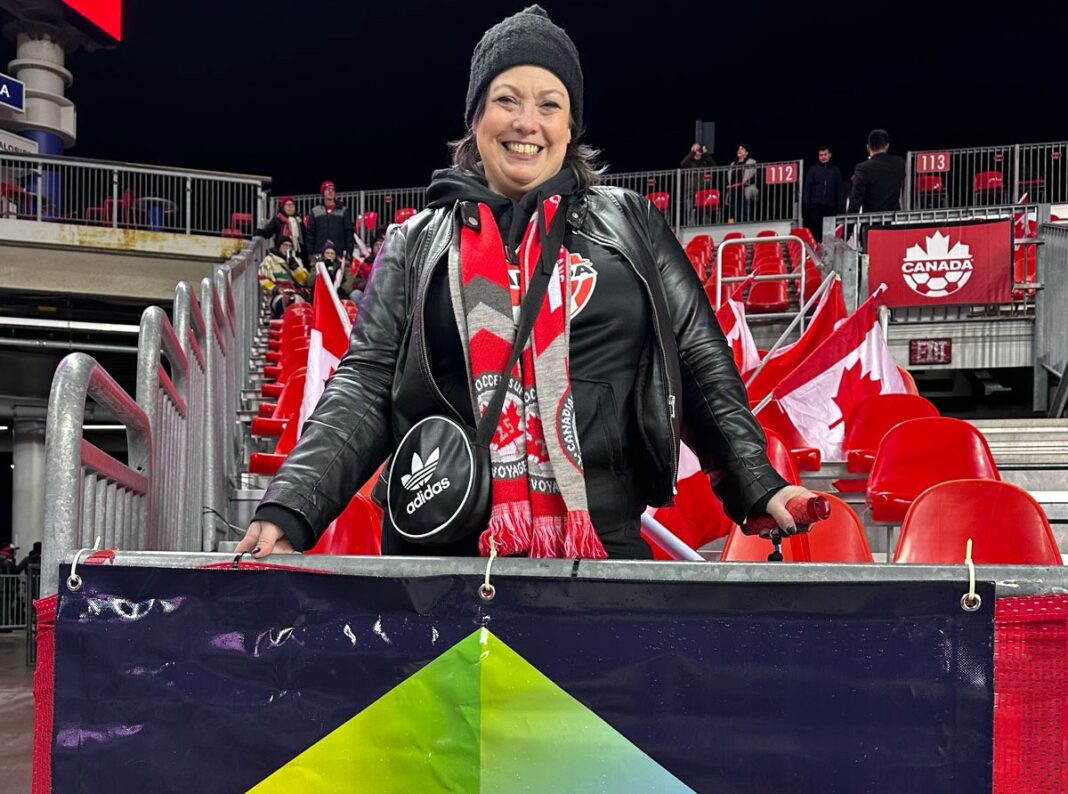
The first Pride House took place 16 years ago, during the 2010 Winter Olympic and Paralympic Games. Local activists organized two pavilions—one in Vancouver and one in the ski resort town of Whistler, British Columbia—that welcomed LGBTQ2S+ athletes, fans and allies during the games.
Like a traditional Olympic “hospitality house,” a dedicated venue typically set up by the host country’s National Olympic Committee as a place for cultural exchange, socializing, networking and fandom, a Pride House celebrates the sports competition, but from a distinctly queer perspective. Always attached to a major sporting event, local organizers follow a sort-of template established by Scotland-based Pride House International, to create, activate and publicize their pavilions. There have been Pride Houses at every Olympics since 2010, as well as at two Pan and Parapan American Games, three Commonwealth Games and several other championships, adding up to 27 Pride Houses so far.
During the 2026 men’s World Cup of soccer (or football, if you prefer), which takes place from June 11 to July 19, there will be a Pride House bonanza. With matches spread across 16 cities in Canada, Mexico and the United States, at least 12 of those cities will host Pride Houses during the 39-day tournament. Though each city will do things a little differently, they’ll all be broadcasting games, presenting cultural programming and performances, and providing space for mixing, mingling and chilling.
Though Toronto has already organized a Pride House, back when the city hosted the 2015 Pan and Parapan American Games, this time out it’s an all-new organizing team and a new venue. From June 11 to July 19, every match will be shown at the George Brown Daphne Cockwell Centre for Health Sciences (51 Dockside Dr., Toronto), a waterfront venue with a spacious lobby with stepped seating.
Pink Ticket Travel talked to Annie Hart, chair of Pride House Toronto, in the early days of planning, about what fun the team has in mind.
How did you come to be leading 2026 Pride House Toronto?
I had done work with Toronto FC on Play Proud, which was a North American–wide soccer initiative for LGBTQ2S+ inclusion. I’m a soccer supporter. I used to run one of the Toronto FC supporter groups. We actually started with very little structure behind us, so we’re having to reinvent a lot of things as we go. But each Pride House does their own thing. They’re completely designed, run, staffed and funded by local teams. The mandate can be as simple as having a table at a pub with a TV that’s dedicated to whatever sport, or it can be on a much larger scale. We’ll be focused on our location at the George Brown Daphne Cockwell Centre for Health Sciences building. But we’ve been talking to Los Angeles—they’re combining their efforts for the Men’s World Cup and their upcoming Olympics in July 2028, so they have a music concert hall and other venues. It’s a very elastic program. I know things in some U.S. cities have been complicated—some of our meetings have been a bit heart-wrenching, to say the least—because of some of the political issues they’re facing that we’re not having to face here.
I know you still have a lot of details to work out, but can you give me a taste of what the experience will be like for a visitor?
We’ve got a single location, and we’ve intentionally kept it away from the congestion of BMO Field (170 Princes’ Blvd., Toronto) and the FIFA Fan Festival (a larger World Cup watch-party event, with live match broadcasts, music, entertainment and food, which will take place at Fort York National Historic Site, 250 Fort York Blvd., Toronto, and The Bentway). The tournament overlaps with Pride Toronto (June 25 to 28), so we expect people will be coming and going from our venue. George Brown Polytechnic has donated space on their waterfront campus, right next to Sugar Beach. It’s a beautiful open space with a little patio that we’re able to licence for alcohol.
We’re going for a pub-style layout: high-top tables, low-top tables, areas where people can congregate with screens. When the games are on, the focus will be strictly on the games, so there won’t be any interruptions. But we’re doing some programming, too. We’re trying to leverage it to empower more voices in our community. Like grassroots soccer programming, 2SLGBTQ+ soccer programming. We are planning to have a screening of Harrison Browne’s film Pink Light, which is a short about the experience of a trans male hockey player. So we may have some crossover with Heated Rivalry!
We have a lot of entertainment connections, so there will be celebrity sightings, VIPs showing up.
We are PG-friendly, especially during the day, so families are welcome, children are welcome. Dogs are allowed outside. The flavour of the place will change depending on who’s playing. We’re doing food and drink service.
We’re also hoping to have a shuttle set up from Union to our location, and possibly from the Pride area as well.
I’m sure local sports fans will swing by. How will you let visitors know what you’re doing?
We have received accreditation from the city that gives us funding and also connects us to Destination Toronto and the city’s FIFA directories. So people will find us in the directories, they’ll find us in some of the publications and promotions coming directly from the city around the World Cup. We’re also connecting directly with international supporter groups. They will be the touchpoint for a lot of people from different countries. Like how the Bayern supporters are the connection for a lot of German supporters. We’re also reaching out to different embassies and different international groups around the city, just to make sure that they know about us.
Especially in Europe there’s been some talk of fans boycotting this World Cup because of what the U.S. government is up to these days, around trans rights and other things. How do you think that will affect things for you in Toronto?
Interest in Canadian games here in Canada has skyrocketed. There are more people focused on the games here and in Mexico as well, which unfortunately has led to an incredible cost increase for tickets to the games. There’s definitely a lot of demand for the games in Canada. People are not as keen to cross the border, but we have so much we can offer here anyway. We do have all the sister houses in the states, and each of them will be an inclusive space. So if Americans are worried about crossing the border to come here, there’s San Francisco, Los Angeles and Miami, all of which are planning pretty robust Pride Houses.
This interview has been edited for length and clarity.